profile photo

Long Le

vlongle@seas.upenn.edugscholar, twitter, github )

I'm a PhD student at the University of Pennsylvania, where my research focuses on robot learning and computer vision. I'm advised by Prof. Eric Eaton, and closely working with Prof. Dinesh Jayaraman and Prof. Lingjie Liu.

I have worked as a Software Engineer at Google (2022), as an Intern at Robotics Institute, CMU (2021), and as an Intern at Instagram (2020).

Please feel free to reach out if you're interested in research discussion / collaboration! I'm also always looking to mentor highly motivated students to work on research projects. Please send me an email if you are interested.

Research

I am interested in scalable robot learning using 3D priors and other foundation models, and real2sim2real simulations to alleviate human efforts. Below are my works.

OmniGuide: Universal Guidance Fields for Enhancing Generalist Robot Policies

Yunzhou Song*, Long Le*, Yong-Hyun Park, Jie Wang, Junyao Shi, Lingjie Liu, Jiatao Gu, Eric Eaton, Dinesh Jayaraman, Kostas Daniilidis

Preprint, 2025

( website, paper (coming soon), )

OmniGuide is a general, unified, and flexible framework for leveraging non-robotic foundation models such as 3D reconstruction, VLM, and hand tracking models to enhance generalist robot policies (VLAs). We model the 3D space as attractive and repulsive fields to steer generalist robot policies (Pi05, GR00T) with minimal latencies.

Maestro: Orchestrating Robotics Modules with Vision-Language Models for Zero-Shot Generalist Robots

Junyao Shi*, Rujia Yang*, Kaitian Chao*, Selina Wan, Yifei Shao, Jiahui Lei, Jianing Qian, Long Le, Pratik Chaudhari, Kostas Daniilidis, Chuan Wen, Dinesh Jayaraman

Preprint, 2025

( website )

We introduce Maestro, a coding VLM agent that composes iverse robotics-related tool modules into programmatic policies. Maestro makes use of modules such as perception, geometry, control, policies, and image editing to deliver a high-performant, and interpretable policy across robot embodiments.

UniPixie: Unified and Probabilistic 3D Physics Learning via Flow Matching

Qilin Huang*, Quynh Anh Huynh*, Long Le*, Chen Wang, Chuhao Chen, Ryan Lucas, Eric Eaton, Lingjie Liu

Preprint, 2025

( website (coming soon), )

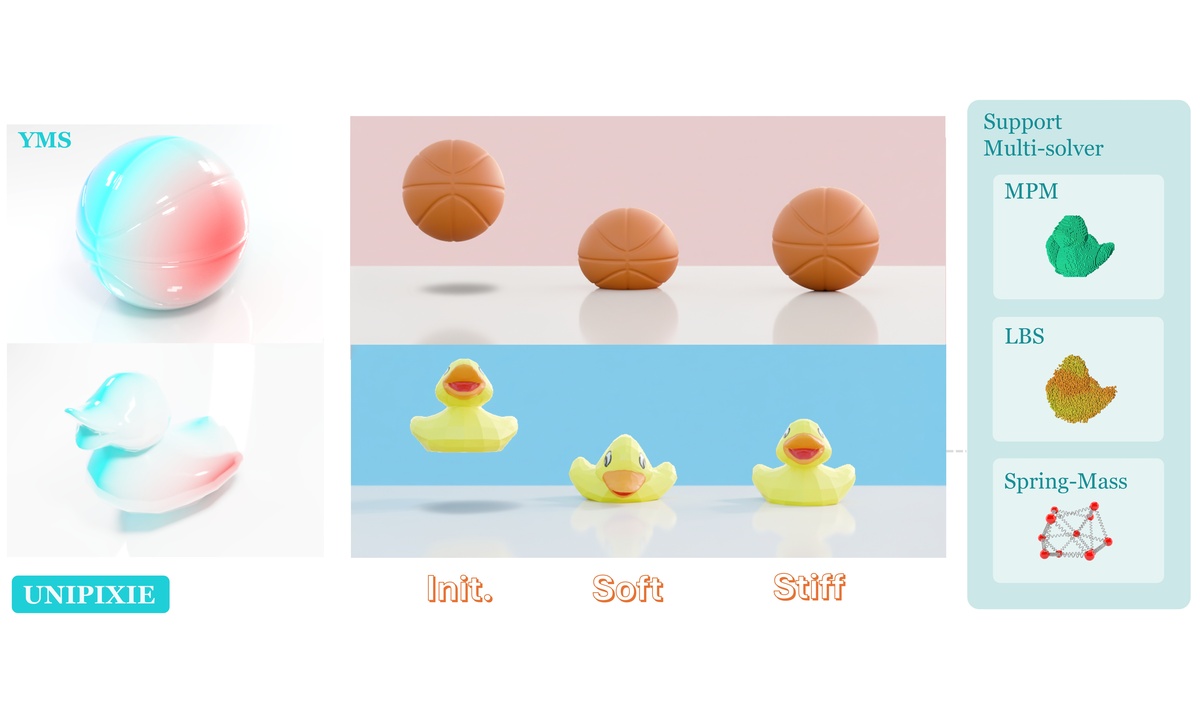
We improved upon Pixie in two ways: (1) controllable generation via flow-matching allowing prediction of soft-to-stiff distribution of plausible materials, and (2) unified architecture for generating simulation-ready parameters for multiple physics solver including Material Point Method (MPM), Linear Blend Skinning (LBS), and Spring-Mass Systems.

Pixie: Physics from Pixels

Long Le, Ryan Lucas, Chen Wang, Chuhao Chen, Dinesh Jayaraman, Eric Eaton, Lingjie Liu

Preprint, 2025

( website, twitter, paper, code )

We predict 3D physics from distilled CLIP features, enabling generalization and fast inference across scenes. Pixie produces physics that are 1.5–4.4× more realistic while running 10³× faster.

Articulate Anything

Long Le, Jason Xie, William Liang, Hung-Ju Wang, Yue Yang, Jason Ma, Kyle Vedder, Arjun Krishna, Dinesh Jayaraman, Eric Eaton

ICLR, 2025

( website, twitter, paper, code )

A major bottleneck in scaling robot learning in simulation is the lack of interactable 3D environments. We present a SOTA method, leveraging VLMs to automatically generate articulated 3D models from any input modality including text, real-world images, or videos.

DCL

Distributed Continual Learning

Long Le, Marcel Hussing, and Eric Eaton

Preprint, 2024

(paper)

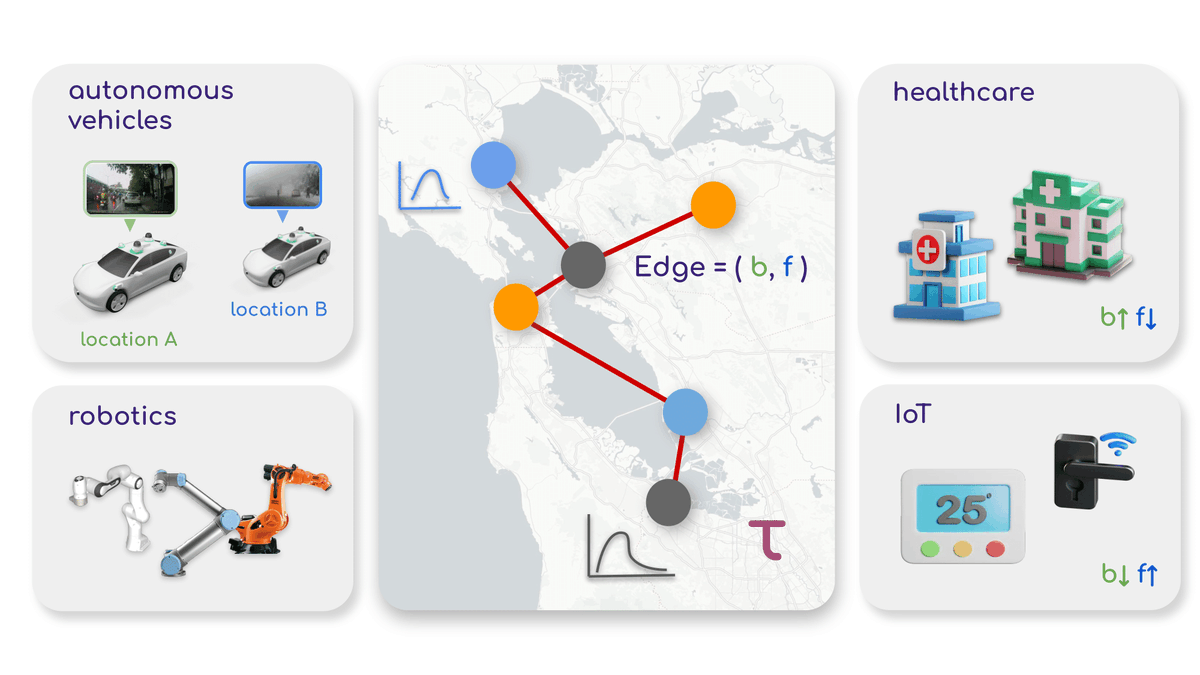
We study the intersection of continual and federated learning, in which independent agents face unique tasks. We develop the mathematical formulation for the setting, develop algorithms for sharing data, model weights, and modules, and provide extensive empirical results across network bandwidths, and topology.

Nature Survey

A collective AI via lifelong learning and sharing at the edge

A Soltoggio et al

Nature Machine Intelligence, 2024

(paper)

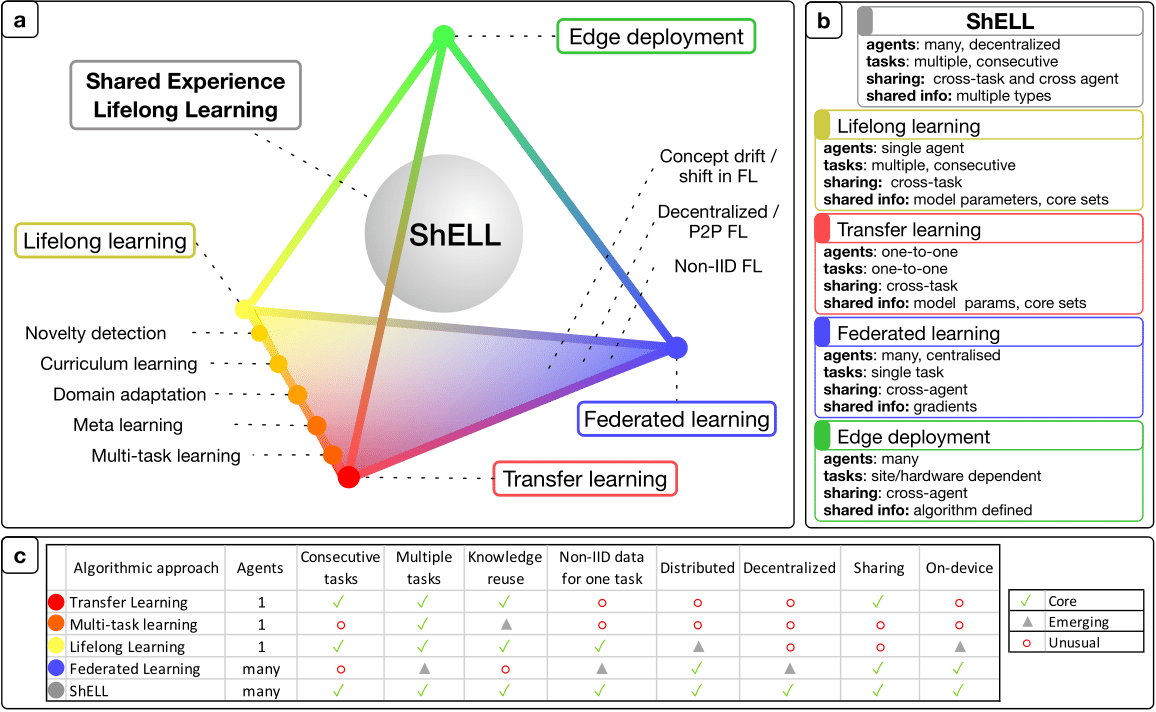
We survey approaches and challenges in developing a collaborative life-long AI system on edge devices.